1864: Surrender at High Trees
June 25, 2025
By AHNZ
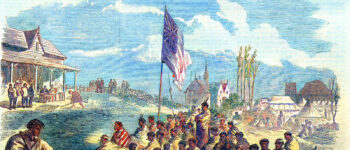
 Peace came to Tauranga as Rawiri Puhirake’s rebellion came to an end with his death on, 21 June, 1864, at the Battle of Te Ranga. After the battle British officers gathered to pay Puhirake their last respects when he was buried the day after.¹ Within 4 days rebels writing letters of loyalty to the Queen and surrendering on Colonel Henry Greer’s front lawn. The war was over.
David/Rawiri Puhirake and his Ngaiterangi tribesmen presided over food and munitions supply lines to the Kingites in the Waikato. When General Duncan Cameron sent soldiers to put a stop to it Puhirake issued a challenge. Right in their faces, 5km away, he constructed Gate Pa and said “come at me!” He even offered to build a road to his fort to make it a bit easier for them.
“As July, 1863, drew to a close, the position at Tauranga became so threatening that it was considered necessary to .abandon the station…the missionaries and their families withdrew to Auckland. It must indeed have seemed that Tauranga as a Mission station was doomed to follow Matamata to extinction.” – Centennial History of Tauranga, Gifford and Williams (1940, ee1976)
” The following force accordingly embarked at Auckland in H.M.S. Miranda and s.s. Corio on January 21st, and landed at Tauranga the following day without opposition….Many of the principal chiefs had asked for an interview with the Officer Commanding, and expressed a feeling of friendship and loyalty, pointing to the Queen’s flag on their settlements.” – Ref. Centennial History of Tauranga, Gifford and Williams (ee1976)
“The Monmouth Redoubt was built by the 43rd Monmouthshire Light Infantry Regiment who had arrived in Tauranga in January 1864. It provided a refuge for women and children who slept on the floor fully dressed during this time, emergency rations and a bottle of water within reach. This and other fortifications cut enemy supply to the Waikato War but also brought the fight back to Tauranga. The famous Gate Pa was created as a reaction to these this Tauranga Campaign in mid-year.” – 1864: Monmouth Redoubt, AHNZ
“Rawiri Puhirake, also known as Rawiri Tuaia and Whakatauhoe, was one of the leaders of Ngai Te Rangi of Tauranga from the 1850s until his death in 1864…He came under the influence of the Christian missionaries who arrived in the Tauranga area in the 1830s, from whom he learned to read and write in Māori. Rawiri (David) was probably taken as a baptismal name.” – Dictionary of New Zealand Biography (1990,) Te Ara
“The suburb of Greerton situated next to the suburb of Gate Pā in Tauranga is named after Henry, as is Greerton Road. In 1979 the servant’s quarters and wash house that stood behind ‘High Trees’ was moved to the Tauranga Historic Village..” – debbiemccauleyauthor.wordpress.com
“This imposing red granite memorial, crafted by W. Parkinson & Co. of Auckland, was erected over Puhirake’s grave five years later. It was unveiled on 21 June 1914 – the 50th anniversary of Puhirake’s death – by Colonel Robert Logan, the officer commanding the Auckland military district. Although the opening of Parliament prevented Cabinet ministers and the governor attending, about 1000 people – including Māori leaders, prominent local Europeans and New Zealand Wars veterans – took part in the proceedings.” – Rawiri Puhirake NZ Wars memorial, NZ History.govt
After storming Gate Pa, at great loss, Cameron’s troops discover Puhirake is rebuilding just 10km away; Te Ranga. Before this fort can be completed it is attacked too and beaten just as easily as Gate Pa. This time they don’t get complacent and let their guard down; They take the win. Puhirake himself is killed in action.
And that about wraps it up for the Tauranga Campaign. In the coming weeks Ngaiterangi surrendered land and arms. The “rebellion had completely collapsed, and the majority of the rebels had brought in their
arms as tokens of submission. This was not all done at one great ceremony, but was a gradual process, as one group after another realised that further resistance was useless.” Ref. Gifford (1940)
Surrender at High Trees
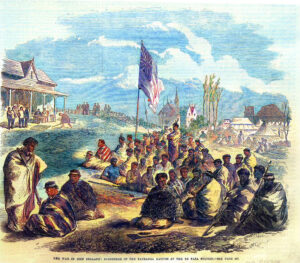
 The main surrender of 133 warriors, including many chiefs of rank, took place on 25 July at High Trees. This was the house of Colonel Greer and his family. The defeated gathered on the lawn sloping down
from the East side of the house. This location is where Durham street forms a T-junction with Harington street so around about where the Tauranga High Court is today. Here they made “a public and absolute submission to the Queen’s authority.”
As part of the peace deal they were given food and seed crops to re-establish themselves as a peaceful and productive part of a growing new New Zealand. Following the surrender, the natives were permitted to remain in the villages of Otumoetai and Maungatapu; Very generous terms. Governor George Grey arrived on 4 August of the same year and ratified the peace at High Trees: “I promised them that in
so far as circumstances would admit, they should be generously treated; that they should for the future be cared for in all respects as other subjects of the Queen’s are, and that the prisoners of war of their tribe should be released, they undertaking to be responsible for their future good conduct.” Ref. Gifford (1940)
‘Colonel, I have been obstinate. I turned a deaf ear to what Te Paraone said to me, and thus I was pulled into the fire. In the day of chastisements I was whipped as a refractory child. The chiefs of Tauranga have been killed; I caused them to be scorched in the fire. Now I am drawn out of the fire. There are a few that are saved. Treat me kindly; I shall cease from evil from this time. Plant the standard of the Queen, that I may know it. Let her flag hang over me. You have behaved liberally to me; may your liberality continue.” – Pene Taka (Gate Pa Engineer,) in surrender, Gifford (1940)
Unfortunately some natives could not make this adjustment and the culture shock was too great; They became religious terrorists. But that’s another story.
For the majority, Grey’s generous terms allowed them to simply be free to get on with their lives as loyal subjects. They had to give up their weapons and part with some land to pay for the enforcement costs yet they were not exiled or imprisoned. Tauranga was set for its remarkable new future thanks to a peace deal that a lot of other countries in conflict around the world today could learn a lot from.
—
1 Ministry for Culture and Heritage (updated 29-May-2024) (Archived)
Image ref. Surrender of Maori at Te Papa, 25 July 1864 showing High Trees (left), the Native Institute (centre,) Illustrated London News (29 Oct 1864,) University of Waikato, taurangahistorical.blogspot.com. AHNZ enhanced (2025)
Image ref. Stone plaque on Rāwiri Puhirake’s grave in the mission cemetery, Tauranga. Jock Phillips, the Encyclopedia of New Zealand. AHNZ captioned
Image ref. Greer’s name is too entrenched now to remove though I’m sure Aotearoians would love to “de-colonise” it if they could. “Greerton Village is Tauranga’s unique, boutique shopping centre.” tauranga.govt.nz
 Like Comment Share