1868: Arrowtown Library
August 12, 2025
By AHNZ
Arrowtown Library opened on 2 May 1868 as the creation of the public rather than The State. However, government has taken the library over many times and run it into the ground. Each time, the Anarchist spirit of free people have raised it back up again only to have it, once again, seized by The State once it was back on its feet as a going concern.
Once again, it’s something the people created which the government only took over later. According to government history the library is only 40 years old as the Otago Daily Times reported: “A celebration on Friday marked the Arrowtown Library’s 40th anniversary..” However, this distracts from the much deeper history of the library to privilege only the government’s latest iteration.
The first Arrowtown Public Library opened in the Library Hall (site of the current Athenaeum Hall) on 2 in May 1868. Ref. Lake Wakatip Mail (7 May 1868,) Papers Past
For 6 glorious, anarchist, years, the library was run by the people for the people. Founders included Alex Innis and the local newspaperman John Miller. During this period the locals themselves advanced Arrowtown while Big Government took little interest in the welfare of the district so long as the tax on gold kept coming.
This was the first library in the Lakes District (Queenstown Borough Council’s famous stone library would not be completed until 1877.) Rather than tax, Arrowtown Library was paid for by voluntary subscriptions and donated books. Within weeks of this success the cunning men of the Arrow expanded their library with a new building partly paid for by getting some of their tax revenue back. They applied for, and evidently received, £100 from the Education Board which the free folk moved into and continued to run for themselves.
Arrowtown had been constituted a borough in 1867 but (most sadly) made the situation worse in April 1874 by becoming its own municipality with Innis the first mayor. The library was at this point taken over by the new local government and, as such, was now in the control of The State. Within 3 years it was being pointed out that nobody seemed to be watching the library now nor reporting on it nor accountable for it. Lake County Press (1877,) Papers Past.
“…successive governments evinced little interest in the welfare of the district, and the Arrow seemed isolated even from the rest of the Wakatipu. So it was over to John and like-minded residents to make a noise. For example, in 1868 they established the Arrowtown Library — a place dear to his heart – and he was on the first committee.” – Marion Borrell, Queenstown Courier (#90, 2013)
“The Arrowtown Library was the first established in The Lakes district and if £100 was granted, a building which would cost more than £200 would be at once proceeded with.” – Otago Witness (July 1868,) Papers Past
By the turn of the century Arrowtown Library was not the people’s library any more. It was part of government, not part of the community. A service expected as of ‘right’ that could be taken for granted. This is what comes of putting anything you care about in to the hands of government. By 1917 there must have been tumbleweeds blowing through the bookshelves as the Tuapeka Times determined not to keep sending a free issue to the library any more. If the council wanted the paper they would have to buy one. For the next 10 years the library was “practically closed” and in need of “resuscitating” as it was observed in 1927.
Instead, it burnt down, as government property is want to do, in 1928 and that was that for the government library. It was not replaced (government being better at taking things off us than providing them.)
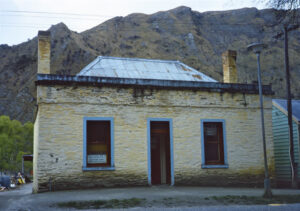 “About 1936, a private library was housed along a wall of Ernie Thomson’s barber’s shop” says ODT (2024) whereupon government returned to the scene with a half-hearted lending desk on Fridays. This picture (left) from 1971 shows the word ‘library’ written in the window of the old Borough Council building.
Then, once again, as in 1868, private enterprises started up another new in 1976. Well we couldn’t have that! In came the government again in 1984 to take over this part of our culture and so it has been these past 40 years. As soon as people start to do something for themselves the government finds it needs to get involved and take it over. The reasoning being, I suppose, that if people are willing to pay for something freely then they can be forced to pay for something by taxation.
“A library committee was set up in 1976, and chairperson/librarian Joy Soper was instrumental in pushing for a permanent library. Its last temporary home, from 1979, was in a room in the Athenaeum Hall….On July 21, 1984, the library was opened by Internal Affairs Minister Allan Highet in his last official engagement as an MP.” – ODT (2024)
The 1984 library cost $110,000 and was financed from the estate of Doris Payne, government gambling proceeds, and a council debt. Within a few years of this local library was amalgamated as was the local council. The big entity, Queenstown Lakes District Council, now makes Arrowtown library one node in a network of 15 libraries. Membership of the library is now “free” (or, rather, hidden in your rates bill) so there’s no way to know how much demand there is. Nor are there any incentives to return books on time or perhaps at all since fees have been abolished. The library is more radically removed from its free market heritage than ever and more and an indistinguishable part of government bureaucracy.
The library is estranged from the feedback it used to have about how must it costs and how much it benefits the people who use it. The public have no idea how much it costs to run and staff the library except for ‘customer satisfaction’ surveys (which show that, even then, targets of 85% satisfaction are not being met.) A hint did come in 2009 when Queenstown Lakes District Council’s “employee expenses” was half a million over-budget and the blame placed on librarians working overtime when they should never have been allowed to. Ref. ODT (2009)
At any rate, the ‘library’ has decided not to be a library any more at all. It’s a “crucial social infrastructure for community well-being” ‘Hub’. Which is to say, The State has imposed on the library and now is using that to impose on every other aspect of our lives too. We will be further estranged from the services we get and how we pay for them.
The decisions about what resources are to be applied and how much the libraries have to grow, what they must do and be, is informed by reports like Queenstown Lakes District Council Libraries Strategy updated (August 2020) by Sue Sutherland Consulting. A report both repetitive and generic and which inexplicably cuts-and-pastes pictures from other libraries far away. Arrowtown Library is part of a massive leviathan beast with occluded benefits and massive costs driving growing debts. History predicts that, as before, the library (or whatever they come to call it in the end) will nose-dive into oblivion in years to come and then be quietly replaced by free people at their own expense.
You’d have to ask yourself if the 2020s Arrowtown Library with its massive bloated budget serves the community any better than the 1860s Arrowtown Library did at a fraction of the cost and to only those who wished to pay it.
—
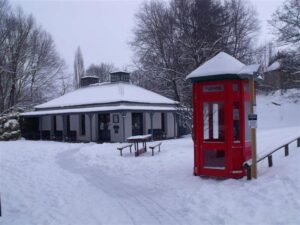
Image ref. Sue Parker, Arrowtown, Facebook (2012)
Image ref. Arrowtown Borough Council offices, Bain/O’Gorman collection 1971. Queensland University of Technology
 Like Comment Share