
1868: The Greymouth Borrow Council
July 16, 2025
By AHNZ
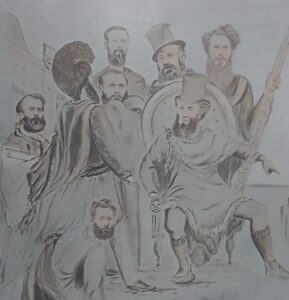 Today in New Zealand history, 16 July, 1868, Greymouth was proclaimed a Borough. The title of the Crown land was shifted from Maori Reserve to the Canterbury Province which welcomed its newest 2 municipalities: Greymouth and Timaru.
AHNZ, and Greymouth Punch, refer to this creation as The Greymouth Borrow Council. Ever since its creation it has been taxing the hell out of the citizen; Farming them really. Although the Greymouth Borough Council was killed off in the Great Amalgamation (1989) its replacement still carries on this heritage tradition. The Grey Council of 2025 is over $6,000,000 in debt which it attributes to a “budging error.” Ref. ‘People make mistakes’: Council uncovers significant budgeting error of almost $6m, Press (2025)
Anarchist Greymouth existed from the day Reuben Waite established his camp in July 1864. In February 1867 a non-state voluntarist entity was elected to run Greymouth. However, the Greymouth Improvement Committee couldn’t resist the lure of power despite members John Whall and James Fisher trying to pull it back. Things have been going downhill ever since!
The Greymouth Improvement Committee

Before government became involved in Greymouth it turns out that free people could voluntarily run society without The State. In the TV drama Deadwood (2004) (image, right) we saw an 1870s gold mining town transition into a municipal entity too. Both Deadwood and Greymouth managed to solve complex social problems without government for years. Likewise, earlier still, New Zealand had the Kororareka Association (1838,) Johnny Jones’ (1835) whaling settler empire, and King of the Coromandel William Webster (‘King of Waiou’ (1836.))
Here are some of the things Greymouth did before the Borough Council came along…
1864 Establish steamship communications
Establish retail outlets
Establish coal mining and exports
Establish a hospitality industry
1865 Establish a Bank of New Zealand and Bank of New South Wales
Self-fund a Town Hall
Establish a newspaper; Grey River Argus
1866 Establish timber mills
Establishment of church and schools
Establish another newspaper; Greymouth Evening Star
Establish a Fire Brigade
Establish the Grey River Hospital
1867 Establish a tramline
Host the eponymous Governor George Grey, and Canterbury Superintendent William Moorhouse
Establish a jockey club; Omoto
Establish a Literary Association
 This non-government civic energy was all paid for by subscriptions. Or, in other words, by voluntary contributions of free people on the basis of their own self-interest. Nobody was forced to pay a tax on threat of being shot if they tried to resist. In February 1867 this energy coalesced into the Greymouth Improvement Committee. It may be that this elected body displaced the less formal social organisation that came before it and had a plan to become the new Boss in town. However, against that, the Improvement Committee was not of one mind about Greymouth becoming a Borough of The State.
John Whall, Chairman of the Improvement Committee, tried to prevent a Borough from going ahead. He had good reasons which were that he wanted any such body to inherit a going concern and not a mess. The people were not ready, the infrastructure wasn’t ready, the legalities were not ready, and the funding was not ready. He would be proven right but nobody was listening.
Likewise Mr James Fisher, drinks manufacturer and publican of the Old England Hotel (image, far right) was a member of the Improvement Committee who tried to stop it becoming an organ of The State. His stance led up to Fisher’s resignation in March and apparent death in December. Ref. Argus, Papers Past and Argus Papers, Papers Past It appears Fisher’s Greymouth-born son kept up the family business on the East coast, moving to Seddon. Ref. New Zealand Pubs Past & Present, Facebook (2021)
Unfortunately the Improvement Committee could not ensure and was steamrolled by the156 eager residents who signed on the dotted line and invited The State closer into their lives.
 The Birth of the Borough
“It was not until June 1868 that Greymouth became a municipality. Early in 1867, an Improvement Committee had looked after the town and its streets. Hokitika already had a fine Town Hall and a municipality to match. Why not Greymouth? So, the Improvement Committee eventually merged into the Borough Council.” – Tales of the Golden West, Waratah (1906)
“The Greymouth Borough Council first came into being as a result of fear of the flood menace from the Grey River. Following the major flood in January, 1868, a meeting was called in the Union Theatre,..Until 1868 the complete responsibility for the Grey district was in the hands of the Resident Magistrate and Warden appointed by the Canterbury Provincial Council, Mr William Horton Revell.” – Greymouth the First 100 Years, Jackson (1968)
“When plunder becomes a way of life for a group of men in a society, over the course of time they create for themselves a legal system and a moral code that glorifies it.” – Frederick Bastiat
“The more the people are discontented with the oppression of taxes, the greater the need the prince has of money to distribute among his partisans and pay the troops that are to suppress all resistance and enable him to plunder at pleasure.” – Benjamin Franklin
Now there were 9 men presiding over a growing port and hills filled with gold, coal, and timber. Greymouth may have been remote from other New Zealand ports but it was a quick shot over to Melbourne and many simply did their shopping there. The Borough Council also became the Port Authority in charge of all harbour affairs including putting levies on all goods, wares, or merchandise coming into or going out of Greymouth. This was terrific power for the new Lords of the Grey. No wonder they were in a hurry to make the deal with The State.
If they had thought, as the editor of the Grey River Argus told everyone, that becoming a Borough would mean that Wellington would be pumping Greymouth full of money and aid they were dead wrong. More like the reverse. The Borough would be a middle-man that had now to make its townsfolk into tax livestock for Big Government while answering all their complaints and fixing their problems. “Mr Harrison’s hopes were soon fulfilled; 156 signatures to the petition were secured, asking the Governor to establish the municipality. Then came a bombshell. The Government refused to advance any money, but informed the residents that they would do the work themselves.” Ref. Jackson (1968)
The Council started deficit financing its balance sheets including an early debt of £5,000 on flood protection which was totally destroyed in the great flood of 1872. Anybody who wanted to import or export would now need to deal with them and pay the fee. General rates and special rates could now be forced on people against their will rather than the former arrangement of voluntary subscriptions. The State had now come to Greymouth; The genie was out of the bottle.
—
Image ref. Greymouth Mayor Edward Masters sits in his new throne. Supposedly this Borrower Council was going repay the power they had been given by holding back the Grey River floods. Cartoon from ‘Greymouth Punch’ c.1858, Lord (1928,) AHNZ enhanced (2025)
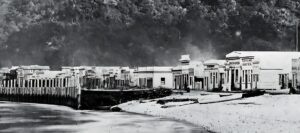
Image ref. Greymouth waterfront 1870s, John Henry Lowe. National Library
Ref. Greymouth Directory (1866,) Greymouth Evening Star (1866,) Papers Past
 Like Comment Share