1952: Broken Barrier
July 10, 2025
By AHNZ
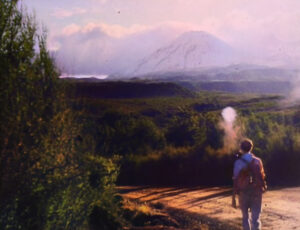 Released 10 July, 1952: Broken Barrier. “The film was the first real attempt at a feature film to be produced in New Zealand since the end of World War II.” Ref. Wiki
One of the two cameras used was acquired “from a dead German in the Western Desert”. This marks it as the art of the Expeditionary Generation with Silent Generation protagonists. Baby Boomer filmmaking was far in the future and would be marked by government handouts and tainted by tax avoidance schemes. The makers of Broken Barrier had to achieve their production in the free market.
These creators were Roger Mirams and John O’Shea operating as Pacific Films. For I think they were influenced, even constrained, by trying to make a movie for us but also the international audience. New Zealand was too small of a market to support our own film industry in competition with Hollywood. In 1952 this little black and white film with separate voice-overed audio track had to go up against full colour blockbusters. These included Ivanhoe, Singin’ in the Rain, The African Queen, High Noon, and The Quiet Man which, like me, you’ve probably seen or know about.
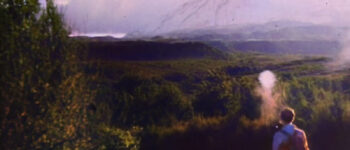
Thus, Broken Barrier was made to pivot around not just the New Zealand audience but also with an eye to what American, British, and the world’s audiences would like to have distributed to them. It showed lots of natural scenes like this one (image above) of Mt Egmont and also the town and country life of our country. Civilization and the rural Maori world make up the plotlines. This sort of orientation marked films of the era but if that seems annoying it’s better than being orientated around pleasing The State isn’t it? Whoever pays the piper calls the tune..
Romance, of course, is also one of the buttons that needs to be pushed so the film had that. A love story between an Ango man and a Maori girl. That would help bring the girls to the cinema.
Action was there too. Emergency, survival, forests and wilderness adventure to give the guys something about the movie to attach to and talk about at the pub.
“There has been a healthy resurgence of the feature film industry since the establishment of the NZ Film Commission in 1978, with administration costs and some funding met by the Department of Internal Affairs. Large sums of money became available under a tax-avoidance procedure which was, however, changed in 1982” – Bateman New Zealand Encyclopedia (ee6 2005)
The way the trailer frames this movie’s theme is telling of its time: “This girl is a Maori…where does she belong? Among her own people or among the Europeans? What world will she choose?” Ref. BROKEN BARRIER [TRAILER,] NZ Sound and Vision
Deconstruct that. New Zealand in 1952 was neither multicultural nor bicultural. The audience knew there was an Anglo world of cities, towns, commercial farms, and Capitalism on one side. On the other was the Maori world which was rustic, rural, Feudal. The movie trailer’s premise was also that an individual could choose which of these worlds to belong to and explored that conflicting choice.
So, along with romance and action and the trying to please international audiences by showing them New Zealand we also have thoughtful exploration of a local social issue.
It was early days, in 1952, for that question being answered. The Baby Boomer Maoris answered it decisively by deciding to migrate to ‘New Zealand’ from ‘Maoriland’ in droves. Into a booming post-war economy that was hungry for their labour. This was the Second Great Migration of the 1960s. By 1974, on New Zealand Day, the Prime Minister was observing it as a fait accompli.
The artists’ vision in Broken Barrier was decades ahead of the politicians’. And we still haven’t figured out quite how to regulate our race relations apart from making appeasement payments to the aggrieved participants. It would be very impressive if anyone dared to make a film in our times that would pick up on the theme of the Broken Barrier and help move New Zealand culture and society forward. Heal some of the “gaps” between Anglo and Maori society. Solve conflicts in ways other than handing over money, property, and two-tier citizenship privileges. We need our artists for this yet, unfortunately, they’re busy scrambling for government-paid arts funding to listen to their own muses or the voice of their aesthetic conscience.
—
Image ref. Scene from Broken Barrier featuring Mt Egmont. AHNZ colourised and enhanced (2025)
 Like Comment Share