
1926: The Information Service
July 14, 2025
By AHNZ
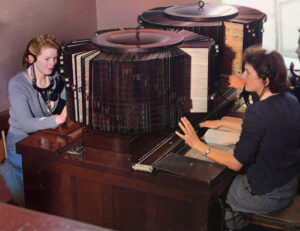 From the late 1920s New Zealand had a human-based information retrieval system. A telephone internet before Teletext. It was staffed by up to 4 operators using 2 rotary directories and run as a sub-department of the telephone exchange which itself was part of the State’s postal system. The information section of the telephone exchange was a bonus service for subscribers of New Zealand’s telephone network.
We have long had a number to call to find out the time. This request was so frequent as to warrant its own phone number: 396. This was handled by one operator doing nothing else but read the time from a clock controlled by the Dominion Observatory. A monotonous job that you’d wonder why our 1920s technically minded ancestors couldn’t have managed to recording playback system.
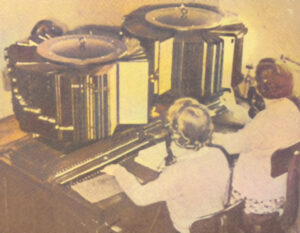
Calling 394 was the main event. This line put you in touch with these girls girls (image, left) who could fieldi information requests for a range of up-to-date information contained on their rotating directory systems. I found another picture of the same set-up in MNZ (1940) captioned “The exchange end of ‘Information’ calls.” (image below)
The directories disseminated facts and knowledge, at least as the government defined it, to anyone who called in. Sports results, weather reports and forecasts, opening hours, visiting hours of public hospitals, shipping, trains, trams, buses, service car timetabless, anniversaries, addresses, business directory,…it was the Google of the past or the Delphic Oracle of the future.
I can see similar rotary desk systems being used in the USA in the 1930s. It may be that the government Post Office imported them. Ref. Wisconsin Historical Society
The UK also had a service like ours which British Telecom offered to those who called 123 for the clock, and 192 for directory assistance and probably more. Ref. BBC (2002)
This service certainly evolved out of a more informal ability to consult the operator for information beyond simply having them place a call for you. I’ve read that the time service was cut off during the 1930s slump. Both time and information may have been re-established later. These photos seem to belong to the late 1930s.
“INFORMATION BUREAU The secretary, General Post Office, announces that in addition to the information at present given to subscribers by the information section at the telephone exchange in regard to sports figures, mail steamers, and other matters of public interest, arrangements have been made for the exchange to be placed in possession of the expected time of arrival of all ferry and passenger steamers…Subscribers may, therefore, obtain such information by dialing No. 394,..” – New Zealand Times (1926,) Papers Past
“This information service has developed from small beginnings. In the early days of telephone exchanges, inquiries to switchboard operators typically consisted of requests for the correct time or for an unlisted or recently changed number. As the telephone system has expanded, so too has the scope of these inquiries. This growth has compelled officials to establish, within the larger exchanges, special departments dedicated solely to handling such requests. This is a purely voluntary service provided by the Department. Although it is offered freely and willingly, there is no obligation for the Department to supply this assistance—a point that some users of the service might do well to remember…At the Wellington exchange, two operators are permanently assigned to this task, with provision made for up to four—an allocation that is, at times, barely sufficient given the extent to which the public makes use of the service.” – Evening Post (13 June 1927,) Papers Past
 The year 1926 seems to be when The Information Service really developed into its own specific thing with dedicated staff and custom whirligigs. Prior to this it was part of the tolls office at the Wellington waterfront. The change probably demonstrates a shift of power over information and control from the wharves to the parliamentary beltway. The Reform Ministry was now under the control of Prime Minister Gordon Coates who won the 1925 election so now one of his first acts of the new year was moving the information hub. Being in control of the State’s repository of information means you can put in or take out “facts” as you like and even decide who will or will not be allowed to retrieve them.
I think, too, that there was a view that New Zealand’s democracy would thrive best if it had good information. Put facts, education, knowledge etc. into the hands of the people and they’ll make the right decisions; Is the general idea. The Labour Party during this time were famous for being well-read and had a reputation for encyclopedic knowledge. Walter Nash, in particular, was a zealot of this particular point of view. They seemed to think that what kept people from seeing things their way was ignorance. If you only knew what Walter knew then you’d be a Commie too!
It may be that the Information Service was a sort of ‘coalition’ deal with the growing Labour Party. Labour probably, quite arrogantly, would have thought that their politics was all fact-based so having telephone fact dispensaries would produce more votes for them. When in power they would see radio the same way. Ref. 1937: The Most Powerful Radio Transmitter in the Southern Hemisphere, AHNZ
However, contrary to our naive 1920s ancestors point of view, information doesn’t work like that. Karl Popper down at Canterbury University would still be figuring on this antiquated view that society and science improved with new and better information. However, David Hume and Thomas Kuhn have explained the more cynical reality of the situation even if we do not, or cannot, accept it even today. Progress doesn’t advance on merit at all, sadly. People’s beliefs are not held because they are true or just but, rather, because they are useful. They are tickets to belonging to a conformity group where you get to make money, buy, sell, marry, be popular, be listened to, genetically reproduce, stay out of jail, etc. To be ‘othered’ out of the social group is death so you must convince others and yourself that you believe in whatever the current conceits are for the times you live in.
Progress doesn’t come one discovery at a time but one funeral at a time. An ivory tower professor doesn’t revise his views when new information comes in, doesn’t surrender his Chair and withdraw. He has to die and be replaced by someone with new ideas. Popper would think that finding new revolutionary archeological evidence about New Zealand’s past would force us to change our understanding of history. But a Kuhnian understanding would predict that such new evidence would be ignored or embargoed or “lost” unless it served the present narrative.
Today New Zealanders have access to more facts and data with faster retrieval than ever before. In the internet we have more information media than the Post Office’s 394 number pipeline could ever dispense. Yet, of course, it hasn’t made us truthful or just citizens or generated consensus of opinion. I think our politicians know that now which is why they are “Communications” (ie propaganda) experts and try to “nudge” us with expensive advertising rather than rationally persuade us.
I suppose Anarchist History of New Zealand has more in common with these whirligigs because it is a dispensary of information rather than a propaganda effort. I’m not telling people how to conform so they can pass government history exams or get jobs at Treasury or remain employed in the health sector. However, unlike 394 line I don’t offer plain dates and facts on call. I offer a perspective on how to view information though an Anarchist lens rather than a mainstream State-Worshipping one. It’s an attempt to put truth, merit, justice, and reality back on the agenda not in spite of their unpopularity and un-usefulness but because they are essential and we should never have turned away from them. Enlightenment vehicles don’t run on facts and data mills but on philosophy.
One thought on "1926: The Information Service"
Leave a Reply to Jess Cancel reply
 Like Comment Share




thanks for all you do, I find your page absolutely brilliant…haven’t been there for a while, but started sharing content, thanks